



TAVI vs Open Heart Surgery: Which Is the Right Treatment for Aortic Stenosis?
September 25, 2026
Being told that you have severe aortic stenosis can raise an immediate question: what happens next?
For patients who need valve replacement, the decision often comes down to TAVI vs open heart surgery. Both approaches can effectively treat a narrowed aortic valve, but they are very different procedures. The right choice depends on age, overall health, heart anatomy, surgical risk, life expectancy and the condition of the valve itself. Modern aortic stenosis treatment is therefore not about choosing the newest procedure. It is about choosing the most appropriate treatment for the individual patient.
What is Aortic Stenosis?
Aortic stenosis occurs when the aortic valve becomes narrowed and cannot open properly. This restricts blood flow from the heart to the rest of the body. As the narrowing becomes more significant, the heart has to work harder to pump blood through the valve. Patients may develop breathlessness, chest discomfort, dizziness, fainting, fatigue or difficulty managing everyday physical activity. When severe aortic stenosis causes symptoms or begins affecting heart function, valve replacement may be recommended. Major international guidelines recognise both transcatheter and surgical replacement as established options, with the final decision based on individual clinical and anatomical factors.
What is TAVI?
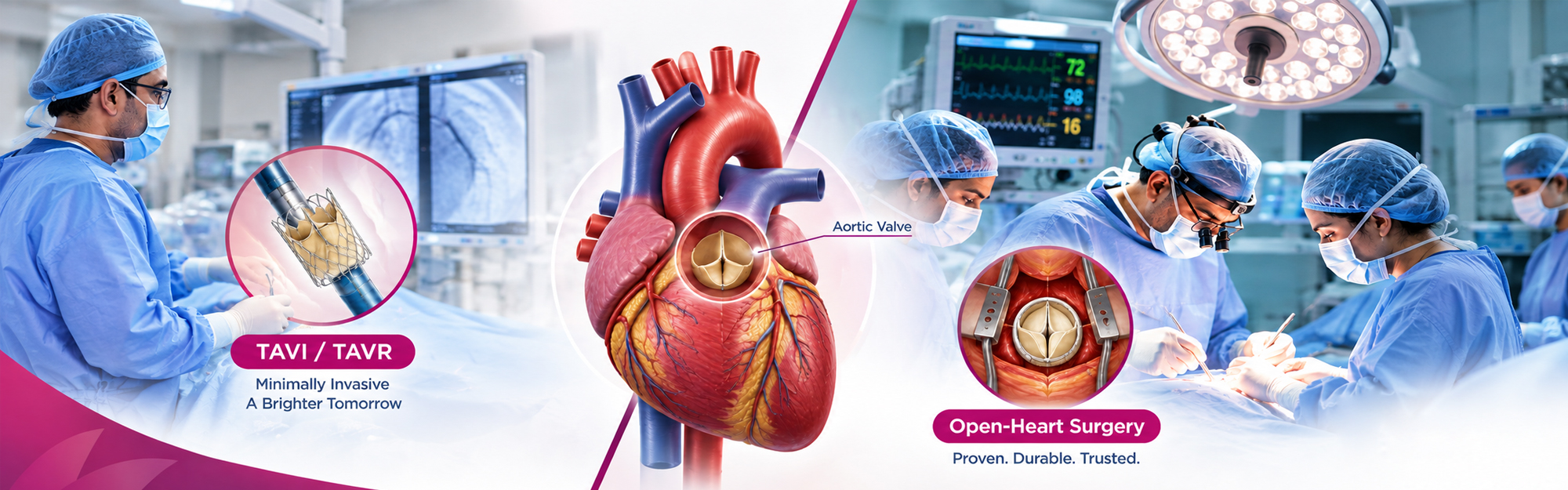
Transcatheter aortic valve replacement, also called TAVI or TAVR, is a minimally invasive method of replacing a diseased aortic valve. Instead of opening the chest, the replacement valve is usually delivered through a catheter inserted into an artery, commonly through the groin. The new valve is positioned within the damaged native valve and begins regulating blood flow. Because there is no conventional open-heart incision, patients undergoing TAVI may experience a shorter hospital stay and a quicker return to routine activities than with surgery. However, suitability depends on vascular access, valve anatomy and other medical considerations. For patients considering a TAVI procedure in Kolkata, evaluation by an experienced multidisciplinary cardiac team is essential before deciding whether the procedure is appropriate.
What is Surgical Aortic Valve Replacement?
Surgical aortic valve replacement, commonly referred to as SAVR, is the traditional surgical method of replacing a severely narrowed aortic valve. During the operation, the surgeon accesses the heart through the chest, removes the diseased valve and replaces it with either a mechanical or biological valve. Although recovery is generally longer than after TAVI, surgery remains an important and highly effective form of aortic valve replacement, particularly for younger patients, patients with anatomy unsuitable for TAVI, or those who require another cardiac procedure at the same time. For example, surgery may be preferred when a patient also requires coronary artery bypass surgery, repair of the aorta or treatment of another heart valve.
TAVI vs Open Heart Surgery: How Are They Different?
The main difference is how the replacement valve reaches the heart. TAVI uses a catheter-based approach, usually without opening the chest. SAVR requires conventional cardiac surgery and cardiopulmonary bypass. TAVI may offer quicker early recovery, less pain, less major bleeding and shorter hospitalisation in appropriate patients. Surgery, however, provides surgeons with direct access to the heart and may offer advantages when additional cardiac problems need to be treated during the same procedure. Neither approach is automatically better. The objective of aortic valve replacement surgery is not simply to complete the procedure with the smallest incision. It is to choose a valve strategy that is safe, durable and appropriate for the patient's long-term needs.
Is TAVI Only for Elderly Patients?
TAVI was initially developed mainly for patients who were considered at high or prohibitive risk from open-heart surgery. Its use has since expanded considerably. Recent European guidance recommends TAVI for many patients aged 70 years or above with suitable tricuspid aortic valve anatomy, while surgery is generally recommended for patients below 70 years who are at low surgical risk. Other international guidelines use somewhat different age thresholds, highlighting the importance of individual Heart Team assessment rather than relying on age alone. Valve durability also matters. Younger patients may live for several decades after treatment, so the expected lifespan of the replacement valve and the possibility of future procedures must be carefully considered.
When May Open-Heart Surgery Be Preferred?
Open-heart surgery may be more appropriate when the patient is younger, has a longer expected lifespan or has anatomical features that make catheter-based treatment unsuitable. It may also be recommended when there is significant coronary artery disease requiring bypass surgery, disease of the ascending aorta, another valve problem requiring correction, or a need for a mechanical valve. This is why surgical aortic valve replacement continues to play a central role in modern cardiac care despite the growing use of catheter-based procedures.

When May TAVI Be Preferred?
TAVI may be particularly valuable for older adults, patients with increased surgical risk, or those for whom avoiding conventional surgery may offer meaningful clinical advantages. A suitable TAVI procedure in Kolkata should always begin with detailed assessment. This may include echocardiography, CT imaging, coronary assessment and evaluation of the blood vessels through which the catheter will pass. The Heart Team also considers frailty, kidney function, lung disease, previous heart surgery and the patient's expected quality of life after treatment.
What Are the Risks?
Both approaches are established treatments, but neither is risk-free. TAVI can be associated with vascular complications, leakage around the implanted valve and the possible need for a permanent pacemaker. Open surgery carries risks associated with major cardiac surgery, including bleeding, infection and a longer recovery period. The balance between benefits and risks therefore has to be considered individually. Current guidelines strongly emphasise shared decision-making between the patient and a multidisciplinary Heart Team.
Which Aortic Stenosis Treatment is Right for You?
There is no single answer for every patient. Someone in their eighties with symptomatic valve narrowing and suitable anatomy may have very different treatment priorities from a physically active patient in their fifties who may need the replacement valve to function for several decades. The decision should consider age, symptoms, valve anatomy, associated heart disease, surgical risk, vascular access, expected longevity and patient preferences. For this reason, discussions about TAVI vs open heart surgery should focus on the patient's entire clinical picture rather than one procedure being described as universally better.
Speak with the Structural Heart team at Woodlands Multispeciality Hospital
To understand whether TAVI may be appropriate for you or your loved one
Conclusion: Choosing the Right Path for Your Heart
Advances in cardiac care mean that patients requiring aortic valve replacement now have more treatment options than ever before. TAVI offers a less invasive route for appropriately selected patients, while conventional surgery remains an important option with a long-established track record. The safest and most effective choice comes from careful assessment, imaging and discussion with an experienced cardiac team. At Woodlands Hospital, patients with aortic valve disease can undergo specialist cardiac evaluation to understand which approach may be appropriate for their condition. Do not let severe valve disease decide your limits. Let the right assessment guide your next step. Visit www.woodlandshospital.in to learn more or book a cardiac consultation.